English
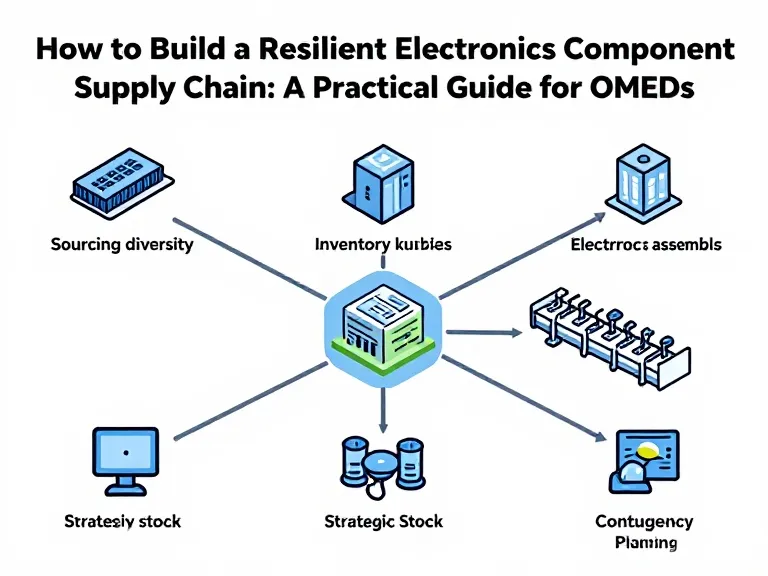
A production schedule is only as reliable as the components behind it. A missing processor, connector, power MOSFET, or passive component can hold up an otherwise complete PCB assembly. The expensive mistake is treating shortages as a purchasing problem alone. In practice, preventing component shortages from delaying electronics production requires coordinated engineering, procurement, supplier management, inventory planning, and production scheduling.
For electronics manufacturers, OEMs, and product developers, the goal should not be to buy as many components as possible. It should be to secure the right parts, in the right quantities, from qualified sources, early enough to protect the build schedule without tying up excessive working capital.
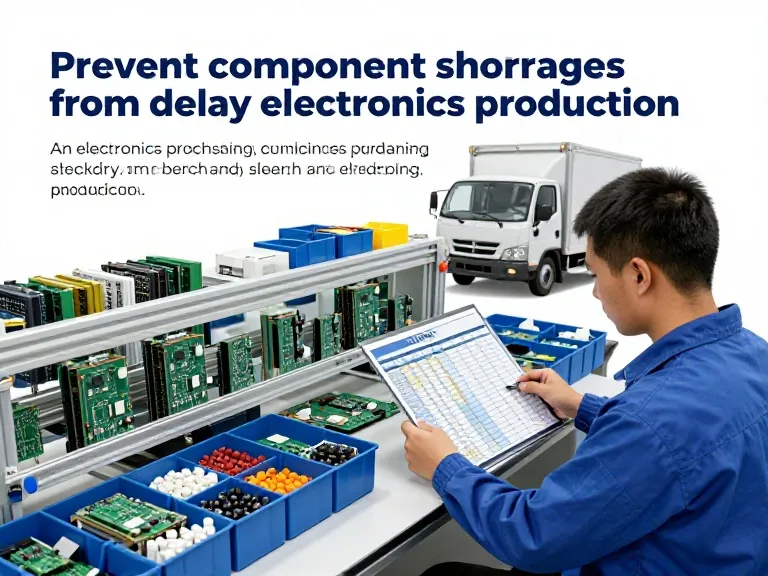
Quick Answer: How Do You Prevent Component Shortages From Delaying Electronics Production?
Prevent component shortages from delaying electronics production by identifying long-lead-time and single-source parts during design, checking real supplier availability before committing to a schedule, qualifying alternative components, maintaining risk-based safety stock, and monitoring purchase orders through delivery and incoming inspection. Share an accurate BOM and forecast with your PCB assembly manufacturer early. Do not wait until the production release date to discover that a critical IC is unavailable.
Our recommendation: Build a component-risk review into every new product introduction and every major production forecast. Prioritize parts that can stop the entire assembly line, rather than applying the same inventory policy to every resistor, capacitor, connector, and IC.
1. Why Component Shortages Delay Electronics Production
Electronics production depends on a coordinated flow of materials. A PCB may be fabricated on time, the assembly line may have available capacity, and the enclosure may already be in stock. Yet the finished product cannot ship if one required component is missing or has not passed incoming inspection.
This is especially important in mixed-component assemblies. A typical board may use hundreds of individual line items, including microcontrollers, memory, power-management ICs, connectors, resistors, capacitors, diodes, sensors, and specialized RF components. Each item has its own manufacturer, lead time, minimum order quantity, packaging requirements, and availability risks.
Consider a practical example: an OEM has scheduled 2,000 control boards for assembly. Most components are available, but a specific power-management IC has a twelve-week lead time. The assembly partner cannot complete the boards without it. Buying more of the readily available components does not solve the bottleneck. The missing IC determines the actual production date.
From our experience, this is why procurement teams should distinguish between ordinary material availability and production-critical availability. A component is production-critical when its absence can stop the build, prevent functional testing, or block shipment.
The real cost extends beyond the missing part
Idle production capacity: Scheduled SMT or through-hole assembly time may be wasted or reassigned.
Expedited freight: Emergency shipments can increase logistics costs and still fail to meet the original deadline.
Engineering rework: Substituting a component at the last minute may require schematic, layout, firmware, or validation changes.
Inventory imbalance: Available components may arrive months before the missing items, tying up cash and storage space.
Customer delivery risk: Late shipments can affect product launches, installation projects, and downstream manufacturing commitments.
The correct response is to manage the component supply chain before the production order becomes urgent.
2. What Component Shortage Risk Means in Electronics Manufacturing
Component shortage risk is the possibility that a required electronic part will not be available in the correct quantity, specification, condition, or delivery window when production needs it. It is broader than a supplier saying an item is out of stock.
A component can appear available online but still be unsuitable for a commercial build. It may be obsolete, allocated to another customer, available only through an unauthorized broker, offered in an incompatible package, or supplied with insufficient traceability documentation.
How component shortages develop
Demand changes: A customer forecast increases, or several manufacturers compete for the same component.
Supply constraints emerge: Production capacity, raw materials, logistics, or regional disruptions limit supply.
Lead times increase: The supplier revises the promised delivery date or allocates available stock.
Procurement reacts too late: The buyer discovers the problem after the PCB production schedule is already committed.
Assembly is delayed: The board cannot proceed through the full production and testing process.
There is also an important distinction between a temporary shortage and an end-of-life problem. A temporary shortage may justify safety stock or a revised purchasing schedule. An end-of-life component usually requires a lifecycle decision, an approved replacement, or a redesign. Treating both situations as ordinary purchasing delays creates unnecessary risk.
3. Identify High-Risk Components Before Production
The most effective shortage prevention starts with the bill of materials (BOM). A BOM should do more than list part numbers and quantities. It should help the engineering and procurement teams understand which components are difficult to source and what happens if one becomes unavailable.
Build a component risk register
For every production-critical part, record the manufacturer part number, approved supplier, estimated lead time, lifecycle status, available stock, minimum order quantity, and approved alternatives. Add the date when the information was last verified. A supplier quotation from several months ago should not be treated as a current availability guarantee.
| Risk factor | What to check | Recommended action |
|---|---|---|
| Long lead time | Supplier-confirmed delivery window and order status | Place orders earlier and review forecast coverage |
| Single-source dependency | Whether only one manufacturer or supplier is approved | Qualify a second source or an engineering-approved equivalent |
| Obsolescence risk | Lifecycle notices, last-time-buy dates, and replacement status | Plan a redesign or controlled last-time buy |
| Allocation risk | Whether supply is confirmed or subject to allocation | Obtain written commitments and monitor order changes |
| Counterfeit exposure | Source authorization, traceability, packaging, and documentation | Use qualified channels and incoming inspection controls |
| High consumption | Monthly usage compared with available inventory | Set replenishment points based on actual demand |
Prioritize parts that can stop the whole build
Not every component deserves the same level of attention. A low-cost resistor may be easy to source from several approved manufacturers. A proprietary processor or specialized connector may have limited alternatives. The second part can create a much larger schedule risk even if its unit price is low.
We recommend ranking parts using three practical questions:
How likely is this part to become unavailable before the next production run?
How difficult is it to qualify a replacement?
How much production or revenue is affected if the part is missing?
Use the answers to create high-, medium-, and low-risk categories. Review high-risk items at every production planning meeting, rather than waiting for a general monthly purchasing review.
4. Improve Supplier Planning and Procurement
Supplier planning should begin before the purchase order is issued. A quoted lead time is not always the same as a confirmed delivery commitment. Buyers need to understand whether the supplier has stock on hand, has production capacity reserved, or is relying on a future replenishment date.
Confirm availability at the time of order
For critical components, ask suppliers to confirm the exact quantity, date, manufacturer part number, country of origin where relevant, and whether the material is physically available. Request updates when the delivery date changes. For long-lead-time parts, a purchase order should be supported by a realistic production forecast, not an optimistic assumption.
Use rolling forecasts instead of isolated orders
A rolling forecast gives suppliers visibility into expected demand over several production cycles. It helps them plan capacity and helps your procurement team identify shortages before they become urgent. Forecasts should be updated when customer demand changes, but avoid treating tentative forecasts as firm orders unless the commercial terms are clear.
Develop more than one qualified supply route
Dual sourcing can reduce dependence on one supplier, but it must be done carefully. Two distributors that obtain parts from the same upstream source may not provide genuine supply diversification. For critical components, evaluate the manufacturer's authorized distribution network and confirm that the alternative source can provide traceable material.
For custom or specialized boards, coordinate material planning with the PCB manufacturer and assembly provider. If the project uses a custom PCB, the board's material, layer count, surface finish, and special requirements should be finalized early enough to avoid creating a second supply bottleneck on the fabrication side.
5. Qualify Alternative Components Before a Shortage Occurs
An approved alternative can protect a production schedule when the original component becomes unavailable. However, a similar-looking part is not automatically interchangeable. Component substitution is an engineering decision, not simply a purchasing shortcut.
Check electrical, mechanical, and manufacturing compatibility
Before approving an alternative, review the electrical ratings, operating temperature, tolerance, package dimensions, pin configuration, footprint, thermal behavior, and relevant reliability requirements. For active devices, firmware compatibility and timing behavior may also matter. For connectors, mechanical fit and mating compatibility are essential.
Even a nominally compatible component can affect board performance. A different capacitor dielectric, for example, may change behavior under voltage and temperature. A substitute MOSFET may have different gate charge or thermal characteristics. An alternate IC may require a firmware change or a new validation cycle.
Use an engineering change control process
Every substitution should be documented. Record the original and replacement part numbers, supplier, technical comparison, test results, approval owner, and the PCB revisions or production lots affected. Update the BOM and assembly documentation so the factory does not accidentally mix unapproved parts.
For beginners, the safest approach is to have the design engineer or qualified engineering team approve every critical substitution. For commercial users managing repeated builds, maintain an approved vendor list and an approved manufacturer part list with alternates already evaluated.
If the board uses specialized materials or electrical requirements, the replacement decision may also affect the PCB itself. For example, RF and high-frequency designs may require careful control of dielectric properties and layout. See the relevant design requirements for radio frequency PCBs and high-frequency PCBs before making changes that could affect signal performance.
6. Use Risk-Based Inventory and Safety Stock
Safety stock is useful when it protects production from a realistic supply risk. It becomes wasteful when every component is stocked in large quantities without considering demand, shelf life, lifecycle status, or replacement availability.
We recommend setting inventory policies according to component criticality and replenishment time. A unique processor with a long lead time may justify additional coverage. A standard resistor available from several qualified sources may not.
Calculate safety stock using demand and supply uncertainty
A basic planning approach is to estimate average usage during replenishment lead time, then add a buffer for demand variation and supplier uncertainty. A simple reorder point can be expressed as:
For example, if a factory uses 100 units of a component per working day and replenishment takes 20 working days, expected lead-time demand is 2,000 units. If the business sets a 500-unit buffer based on demand variability and supply risk, the reorder point is 2,500 units.
This is a planning illustration, not a universal inventory formula. Real calculations should account for forecast accuracy, order frequency, supplier reliability, minimum order quantities, and the cost of a production interruption.
Protect inventory quality as well as quantity
Electronic components can be damaged by moisture, electrostatic discharge, oxidation, improper handling, and unsuitable storage. Moisture-sensitive devices may require controlled storage and handling under applicable industry requirements. A component that is physically in the warehouse but unsuitable for assembly is not usable production inventory.
For parts with storage-life limits or special handling needs, track date codes, lot numbers, packaging condition, and storage status. Apply first-in, first-out practices where appropriate, while respecting manufacturer-specific handling instructions.
Avoid speculative overbuying
Buying excess components can reduce shortage risk, but it also creates exposure to engineering changes, product redesigns, demand reductions, and obsolescence. For commercial users, the right decision is a cost-benefit calculation: compare the carrying cost and potential write-off of extra inventory with the financial impact of a delayed production run.
7. Coordinate With Your PCB Assembly Manufacturer
Your PCB assembly manufacturer should be involved in material planning before the production date is fixed. The manufacturer can help review the BOM, identify sourcing concerns, check component packaging and availability, and coordinate the assembly schedule around material readiness.
This is particularly important when a project moves from prototype to volume production. A component that is easy to obtain for a small prototype may become difficult to secure in the quantities needed for recurring commercial builds.
Share complete production information early
Provide the assembly partner with the latest BOM, Gerber files, pick-and-place data, assembly drawings, approved substitutions, and expected quantities. Clearly identify customer-supplied components and parts that the manufacturer is expected to source. Version control matters: an outdated BOM can cause incorrect purchasing even when the supplier is reliable.
Understand turnkey and consigned material models
In turnkey assembly, the manufacturer sources most or all required components. This can simplify coordination and give the assembly provider more control over material readiness. However, the buyer should still understand the sourcing policy, component traceability, quotation validity, and approval process for substitutions.
In consigned assembly, the customer supplies some or all components. This gives the customer direct control over purchasing but also makes the customer responsible for ensuring that all parts arrive in the correct quantities and condition. A hybrid model may be practical when the customer has strategic supply agreements for certain ICs but wants the manufacturer to source standard components.
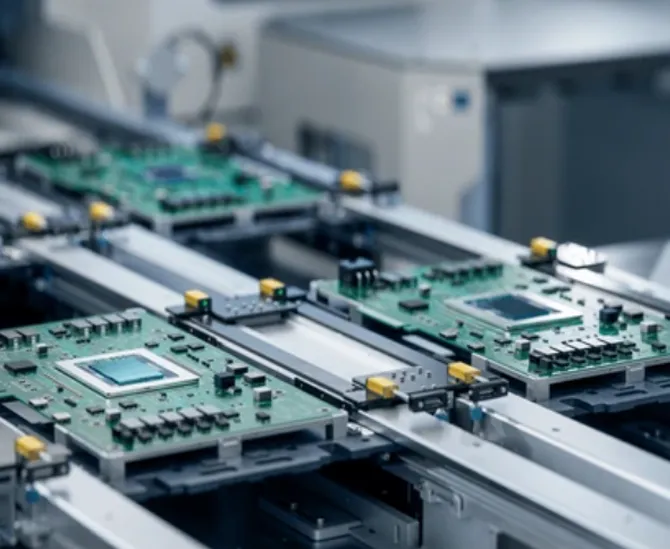
SMT PCB Assembly Services From 365PCB
China 365PCB provides SMT PCB assembly services using automated SMT production lines for prototype and volume manufacturing. The service supports a range of component types, including 0402 chip components, fine-pitch ICs, and BGA packages, with lead-free RoHS and leaded soldering options.
365PCB's no-MOQ positioning can be useful when a project needs prototype assembly or a smaller initial build before scaling. For buyers managing component shortages, the important step is to coordinate the BOM, material sourcing responsibilities, and confirmed production schedule before releasing the order.
Ask the manufacturer the right questions
Which BOM items have long or uncertain lead times?
Are quoted components sourced through authorized or otherwise qualified channels?
Will the manufacturer request approval before substituting a part?
How are lot traceability and incoming material inspections handled?
What happens if one component is delayed after the production schedule is confirmed?
Can the build be split into batches when partial material is available?
A capable manufacturing partner should be willing to discuss these issues before a shortage becomes an emergency. If your project requires a rapid prototype cycle, a dedicated quick-turn PCB service may help shorten the board fabrication stage, but it cannot compensate for missing or unqualified components. Material readiness and PCB lead time must be planned together.
8. Make Production Scheduling More Flexible
Even a well-managed supply chain will experience occasional delays. The objective is to reduce the impact on the overall production plan. Flexible scheduling allows manufacturers to keep work moving when a specific component or assembly is not ready.
Use material-readiness gates
Before confirming a production start date, check whether all critical components are available, whether incoming inspection is complete, and whether the PCB fabrication schedule supports the planned assembly date. A material-readiness gate prevents a production slot from being committed on the assumption that an unconfirmed shipment will arrive on time.
Consider split builds carefully
If 80% of the required components are ready, a partial build may be possible. However, splitting production only makes sense when the missing components do not affect the functionality or completion of the planned batch. It can also increase setup, handling, and logistics costs.
For example, producing a first batch for engineering validation while waiting for a delayed component may be worthwhile. Producing thousands of incomplete boards that cannot be tested, shipped, or used may simply move the inventory problem from the component warehouse to work in progress.
Keep PCB fabrication and assembly plans aligned
Component availability is only one part of the schedule. PCB fabrication can also become a bottleneck when the design requires specialized materials, finishes, or complex construction. If the design needs a hard gold PCB or another specialized board type, include its actual fabrication lead time in the integrated schedule.
For products moving into sustained demand, forecast the transition from prototype quantities to repeat orders. A high-volume production PCB plan should be based on realistic material availability, manufacturing capacity, and approved design revisions rather than simply multiplying the prototype order quantity.
9. Component Shortage Prevention Methods Compared
There is no single method that eliminates every shortage. The best approach combines early risk identification, qualified sourcing, engineering-approved alternatives, and inventory policies that match the actual component risk.
| Method | Best use case | Main advantage | Limitation | Our recommendation |
|---|---|---|---|---|
| Early BOM risk review | New product introduction and every major design revision | Finds supply risks before production commitments | Requires accurate BOM data and engineering input | Make it mandatory for every production release |
| Dual sourcing | Critical parts with credible alternative manufacturers or suppliers | Reduces dependence on one supply route | Alternatives need technical and quality approval | Prioritize high-impact single-source parts |
| Safety stock | Long-lead-time or high-impact components | Provides a buffer against delivery uncertainty | Uses working capital and may become obsolete | Use risk-based quantities, not blanket stockpiling |
| Rolling forecasts | Recurring production and stable supplier relationships | Improves visibility into future demand | Forecasts are not always firm supply commitments | Review and update regularly with suppliers |
| Turnkey PCB assembly | Customers seeking integrated sourcing and assembly coordination | Reduces the number of separate purchasing interfaces | Requires sourcing transparency and clear approval rules | Use a manufacturer with documented material controls |
| Last-time buy | Confirmed end-of-life components with no practical replacement | Can protect a defined remaining production requirement | Creates long-term inventory and demand risk | Use only with lifecycle and financial analysis |
For most electronics businesses, the strongest combination is an early BOM risk review, qualified alternatives for critical parts, rolling supplier forecasts, and selective safety stock. More expensive measures should be reserved for components where the cost of a production interruption is genuinely high.
10. Pros and Cons of Common Component Shortage Prevention Strategies
Prevention has a cost. The commercial decision is whether the cost of a control is lower than the expected cost of a shortage. The table below summarizes the trade-offs that procurement and manufacturing teams should consider.
| Strategy | Pros | Cons | When it is worth using |
|---|---|---|---|
| Safety stock | Reduces exposure to short-term supply disruptions; can protect planned builds | Increases inventory carrying cost; risks obsolescence and excess stock | Critical components with long or variable replenishment times |
| Approved alternatives | Creates sourcing flexibility and may shorten recovery time | Requires engineering evaluation, testing, and documentation | Parts with limited supply or a history of allocation |
| Dual sourcing | Reduces dependence on one supplier and improves negotiation options | Can increase qualification, purchasing, and quality-management workload | High-impact parts used across recurring production runs |
| Turnkey assembly | Consolidates sourcing and manufacturing coordination | Less direct purchasing control unless responsibilities are clearly defined | Projects where integrated material management is valuable |
| Last-time buy | May secure supply for products using discontinued components | Can lock cash into inventory that may not be consumed | Only when product demand and remaining lifecycle are well understood |
For most professional situations, we would not recommend relying on inventory alone. A warehouse full of parts cannot protect a product if those parts are incompatible with a revised design or cannot be traced to an acceptable source. Supply flexibility and engineering control are just as important as quantity.
11. Common Mistakes That Allow Component Shortages to Delay Electronics Production
Mistake 1: Waiting until the production order to check availability
By that point, long-lead-time parts may already be allocated. Review supply risk during design and quotation, then verify it again before production release.
Mistake 2: Treating every BOM line as equally important
Not all parts have the same shortage impact. Focus on unique ICs, specialized connectors, high-consumption components, and parts with limited qualified sources.
Mistake 3: Assuming a distributor listing guarantees stock
Online availability can change quickly. Confirm the actual quantity, source, condition, and delivery commitment before using a listing to support a production schedule.
Mistake 4: Substituting parts without engineering approval
A replacement can affect electrical performance, reliability, thermal behavior, or regulatory compliance. Require documented approval and appropriate validation.
Mistake 5: Buying excessive quantities without lifecycle planning
Overbuying may solve a short-term shortage but create a longer-term write-off when a product is redesigned or demand falls. Base purchase quantities on forecast consumption and component lifecycle.
Mistake 6: Failing to communicate changes to the assembly factory
Late BOM updates, unapproved alternates, or unclear customer-supplied material responsibilities can create avoidable production errors. Maintain one controlled BOM revision and communicate changes formally.
Mistake 7: Ignoring inspection and traceability
Urgent purchasing can tempt teams to use questionable sources. That may introduce counterfeit, damaged, or nonconforming components. Incoming inspection and traceability should not be waived simply to recover a schedule.
12. How to Choose a PCB Assembly Manufacturer That Helps Prevent Shortages
A PCB assembly partner can reduce coordination problems, but the lowest assembly quotation does not automatically provide the best protection against component shortages. Evaluate the manufacturer's material planning, sourcing process, engineering communication, and production controls alongside price.
Evaluate sourcing transparency
Ask how the manufacturer sources components, whether it can provide manufacturer part numbers and traceability information, and how it handles parts that are unavailable. Confirm whether substitutions require written customer approval. A clear sourcing process is more valuable than a vague promise that all materials will be available.
Check manufacturing and inspection capabilities
Look for appropriate SMT equipment, process controls, inspection capability, and experience with the package types used in your design. Fine-pitch ICs and BGA components may require different process controls from simple passive-component assemblies.
Inspection should match the risks of the product. Depending on the design and acceptance requirements, this may include AOI, X-ray inspection for hidden solder joints, and electrical testing. Review whether the provider offers services such as PCB electrical testing, PCB AOI inspection, and PCB X-ray inspection.
Compare total cost, not just assembly price
A lower unit assembly price can be outweighed by poor sourcing visibility, repeated schedule changes, excessive material handling, or weak inspection controls. Compare the full commercial picture:
Component pricing and quotation validity
Material sourcing fees and minimum order quantities
Lead-time commitments and schedule communication
Incoming inspection and traceability processes
Engineering support for BOM issues and approved alternatives
Rework, scrap, and production recovery arrangements
For a prototype or low-volume project, responsive communication and flexible order quantities may be more important than a small unit-price difference. For recurring commercial production, consistent sourcing controls and reliable material planning become more important.
13. Expert Recommendation: Build Shortage Prevention Into the Production Process
Our recommendation is to stop treating component availability as a final purchasing checkpoint. It should be a controlled part of product development, quotation, production planning, and ongoing manufacturing.
For beginners, start with a clean BOM, verify availability for every critical component, and identify at least one technically acceptable alternative where practical. This simple discipline can prevent many avoidable delays.
For commercial users, establish a recurring component-risk review. Connect procurement forecasts with the production schedule, monitor supplier delivery performance, and set safety-stock levels for the parts that could stop a build. Assign clear ownership: engineering approves technical substitutions, procurement confirms supply, and manufacturing validates production readiness.
For heavy-duty applications, industrial electronics, or products with long service lives, pay particular attention to component lifecycle status, operating temperature, environmental ratings, and long-term sourcing. A substitute that works in a prototype may not be appropriate for a product expected to operate reliably for years.
When selecting a manufacturing partner, choose one that discusses material risks before accepting the production schedule. 365PCB's SMT PCB assembly services support prototype and volume assembly, including automated placement of fine-pitch and BGA components. The most effective results come when customers and the assembly team review the BOM, material responsibilities, inspection requirements, and schedule together.
Ultimately, preventing component shortages from delaying electronics production is not about predicting every supply-chain disruption. It is about identifying the parts that matter most, creating credible alternatives, and making decisions early enough that one missing component does not become a factory-wide problem.
14. Quick Summary: How to Prevent Component Shortages From Delaying Electronics Production
| Action | What to do | Business value | Priority |
|---|---|---|---|
| Review the BOM early | Identify long-lead-time, single-source, and lifecycle-risk parts | Finds problems before production release | Essential |
| Confirm supplier availability | Verify quantities, sources, and delivery dates | Reduces schedule assumptions | Essential |
| Qualify alternatives | Approve replacements through engineering and testing | Creates recovery options | High |
| Set safety stock | Protect critical parts using risk-based inventory levels | Buffers supply uncertainty | High |
| Share rolling forecasts | Give suppliers and manufacturers visibility into demand | Improves material planning | High |
| Coordinate with assembly partner | Align BOM revisions, sourcing responsibilities, and production dates | Reduces handoff errors | Essential |
| Control incoming materials | Verify quality, condition, and traceability | Prevents unusable material from entering production | Essential |
15. Frequently Asked Questions
1. What is the most common cause of component shortages in electronics manufacturing?
Common causes include sudden demand changes, limited semiconductor production capacity, long supplier lead times, allocation, lifecycle discontinuation, and dependence on a single source. In many cases, the immediate production delay occurs because the shortage was not identified early enough in the BOM review and procurement process.
2. How can manufacturers prevent component shortages from delaying electronics production?
Manufacturers should review the BOM early, identify critical and long-lead-time parts, confirm supplier availability, qualify engineering-approved alternatives, maintain selective safety stock, and coordinate material planning with the PCB assembly provider. Regular forecast updates are also important for recurring production.
3. Should electronics manufacturers keep extra components in stock?
Yes, but selectively. Safety stock is most useful for high-impact components with long or uncertain replenishment times. Stocking every component in excess can increase carrying costs and create obsolescence risk. Inventory levels should reflect demand, lead time, supplier reliability, and the cost of a production interruption.
4. What components should receive the highest shortage-risk priority?
Prioritize components that are difficult to replace, have long lead times, come from a single approved source, are subject to allocation, or can stop the entire assembly. Examples may include specialized processors, memory devices, power-management ICs, custom connectors, and application-specific components.
5. Can an alternative electronic component be used when the original part is unavailable?
Yes, if it is technically suitable and formally approved. Review electrical characteristics, package dimensions, pin configuration, operating conditions, firmware implications, and reliability requirements. Document the substitution and perform appropriate validation before releasing it to production.
6. Is turnkey PCB assembly better for preventing component shortages?
Turnkey assembly can simplify material coordination because the manufacturer manages component sourcing and assembly planning. It is not automatically better in every case. Buyers should review sourcing transparency, traceability, quotation validity, substitution approval rules, and how shortages are communicated. A hybrid model may be more appropriate when the customer controls strategic components.
7. How early should components be ordered before PCB assembly?
There is no universal ordering window. Timing depends on the component's confirmed lead time, supplier reliability, order quantity, lifecycle status, and the assembly schedule. Critical long-lead-time parts should be checked during design and quotation, then ordered early enough to arrive and pass inspection before the planned build.
8. What should a buyer ask a PCB assembly manufacturer about component sourcing?
Ask where components are sourced, how availability is confirmed, whether traceability documents are provided, how incoming inspection is handled, and whether substitutions require written approval. Also ask how the manufacturer manages schedule changes when a critical component is delayed.
9. Does quick-turn PCB fabrication solve component shortages?
No. Quick-turn fabrication can reduce the time needed to manufacture bare PCBs, but it does not make unavailable electronic components available. PCB fabrication, component procurement, and assembly must be planned as connected activities. A faster board is useful only when the material and assembly schedule can support it.
10. How can a manufacturer reduce the risk of obsolete components?
Monitor manufacturer lifecycle notices, review product roadmaps, qualify replacement parts where possible, and maintain a controlled last-time-buy plan when a component is discontinued. For products with long service lives, lifecycle planning should be part of the original design and sourcing strategy rather than an emergency response.
16. References and Industry Resources
The following organizations provide relevant guidance for electronics manufacturing quality, component handling, and supply-chain risk management. Always consult the applicable current revision and the specific requirements of your product and customer.
IPC – Association Connecting Electronics Industries. Industry standards and resources covering electronic assembly, PCB manufacturing, workmanship, and quality requirements.
NIST Manufacturing Extension Partnership (MEP). Manufacturing improvement resources for supply-chain resilience, operational performance, and supplier management.
NHS Supply Chain. Public-sector supply-chain resources and procurement guidance relevant to supplier continuity and material planning practices.
Standards, supplier lead times, and component lifecycle information can change. Confirm current technical and commercial requirements before making production or purchasing decisions.