English
Choosing a Microelectronics Manufacturing Partner is not simply a sourcing exercise. The wrong supplier can turn a technically sound design into months of engineering changes, inconsistent assemblies, delayed qualification, and expensive field failures. The right partner should do more than quote a low unit price: it should understand your product, identify manufacturing risks early, document process control, and scale production without sacrificing quality.

Quick Answer: What Should You Look for in a Microelectronics Manufacturing Partner?
Choose a partner with proven experience in your product category, documented quality processes, capable PCB fabrication and assembly, traceable materials, suitable inspection and test equipment, engineering support, and a credible plan for scaling from prototype to production. Verify these capabilities with process evidence, sample records, a technical review, and a pilot build. Do not select a supplier on price, certifications, or equipment lists alone.
For complex electronics, the strongest partner is usually the one that can identify a design or process risk before it becomes a production defect. That capability often delivers more value than a small difference in the initial quotation.
Direct Answer: How Do You Choose the Right Microelectronics Manufacturing Partner?
Start by defining what you need manufactured, then assess suppliers against the actual technical and commercial demands of that product. A company assembling simple consumer electronics does not automatically have the process control needed for fine-pitch BGA, high-density interconnect (HDI), automotive electronics, medical devices, RF assemblies, or high-reliability industrial systems.
From our experience in PCB manufacturing and assembly, a dependable supplier must connect four disciplines: engineering, fabrication, assembly, and quality verification. If any one of these is weak, the entire product can be exposed. A capable SMT line cannot compensate for poor component traceability. A sophisticated AOI machine cannot detect every hidden solder-joint defect. A technically strong PCB layout can still be difficult to manufacture if the stack-up, tolerances, or material selection have not been agreed with the fabricator.
We recommend evaluating the complete manufacturing process rather than treating PCB fabrication, component sourcing, assembly, and testing as unrelated purchasing decisions. This is particularly important when your product has tight electrical tolerances, demanding operating conditions, regulatory obligations, or a long service life.
365PCB's practical position: Choose a manufacturing partner that can explain how it will build, inspect, test, document, and improve your product. A supplier that only sends a price and lead time has not yet demonstrated manufacturing capability.
Quick Summary: Microelectronics Manufacturing Partner Selection
| Selection Area | What to Verify | Why It Matters | Priority |
|---|---|---|---|
| Relevant technical experience | Similar board types, packages, materials, and product applications | Reduces the risk of learning critical processes on your project | Essential |
| Quality management | Documented procedures, audits, corrective actions, and applicable certifications | Shows whether processes are controlled and repeatable | Essential |
| PCB fabrication capability | Layer count, HDI, materials, tolerances, copper weights, and stack-up support | Determines whether the design can be fabricated reliably | Essential for complex boards |
| Assembly capability | SMT, through-hole, fine-pitch, BGA, rework, and process controls | Controls assembly quality and component compatibility | Essential |
| Inspection and testing | AOI, X-ray, electrical testing, functional test, and inspection records | Finds defects and provides evidence of product conformity | Essential |
| Component sourcing | Approved suppliers, authenticity controls, lot traceability, and obsolescence planning | Protects supply continuity and reduces counterfeit risk | High |
| Engineering support | DFM, DFA, NPI, stack-up review, and engineering change control | Prevents avoidable redesign and production delays | High |
| Capacity and scalability | Available line capacity, process bottlenecks, and ramp-up planning | Ensures prototype success can translate into stable production | High |
| Commercial transparency | Clear quotation assumptions, tooling, NRE, yield, lead time, and payment terms | Prevents hidden costs and unrealistic schedules | High |
What Is a Microelectronics Manufacturing Partner?
A Microelectronics Manufacturing Partner is a company that supports the production of electronic assemblies or devices containing integrated circuits, semiconductor components, printed circuit boards, and associated interconnections. Depending on the business model, its responsibilities may include PCB fabrication, electronic component procurement, SMT and through-hole assembly, inspection, testing, box build, and production support.
The term can cover very different levels of manufacturing complexity. One supplier may focus on standard PCB assembly, while another may support fine-pitch components, BGA packages, HDI boards, RF circuits, rigid-flex designs, or highly controlled electronics for demanding industries. The label alone does not prove that a supplier can manufacture your product.
How the Manufacturing Partnership Works
A typical project begins with engineering data: schematic and layout files, Gerber or other fabrication data, drill files, bill of materials (BOM), assembly drawings, and product requirements. The manufacturing partner reviews the package, identifies questions, confirms materials and processes, and prepares a quotation and production plan.
After engineering approval, the supplier procures materials, fabricates or receives the bare PCBs, assembles components, performs inspections and tests, and releases conforming products. For repeat production, the relationship continues through revision control, yield monitoring, corrective action, component lifecycle management, and continuous improvement.
A strong partnership is therefore more than a purchase order. It is a technical working relationship with agreed responsibilities, measurable quality expectations, and clear communication at every stage.
12 Criteria for Choosing a Reliable Microelectronics Manufacturing Partner
1. Relevant Product and Process Experience
Ask whether the supplier has built products with similar technical requirements. Experience with ordinary two-layer consumer boards does not automatically demonstrate competence in HDI, fine-pitch BGA, RF, high-speed digital, high-voltage, or rigid-flex manufacturing.
Request examples of comparable work, with commercially sensitive details removed if necessary. Discuss board layer count, component pitch, package types, materials, surface finishes, inspection methods, and production volume. A capable engineering team should be able to explain the process challenges rather than simply claim that it can build any PCB.
Our recommendation: Prioritize relevant process experience over a broad but unverified capability list.
2. A Documented Quality Management System
Quality should be built into the process, not added as a final inspection step. Review the supplier's quality management system, document control, incoming inspection, process monitoring, nonconformance handling, corrective action, and final release procedures.
Ask which certifications are current, which facility and activities they cover, and whether the scope matches your product. ISO 9001 can provide a framework for quality management, but a certificate alone does not prove that a particular production line or product will meet your requirements. Industry-specific requirements may apply to automotive, medical, aerospace, or other regulated applications.
For high-reliability work, request actual quality records and examples of how the supplier handles a defect, root-cause investigation, containment, and corrective action.
3. PCB Fabrication Capability That Matches Your Design
PCB capability should be checked against the design's actual manufacturing constraints. Relevant parameters include layer count, board thickness, copper weight, minimum trace width and spacing, drill diameter, aspect ratio, via type, surface finish, material system, impedance control, and dimensional tolerances.
For HDI projects, confirm the supplier's experience with microvias, stacked or staggered via structures, sequential lamination, via filling, and the specific build-up technology required. For RF or high-speed applications, discuss dielectric properties, copper roughness, impedance tolerances, and stack-up control before finalizing the layout.
Review the supplier's high-speed PCB capabilities if your product contains fast interfaces or controlled-impedance signals. For advanced package-related designs, check whether its FC-CSP PCB experience is relevant to your application.
4. SMT and Through-Hole Assembly Capability
Assembly capability must match the components and process requirements in your BOM. Ask about SMT line configuration, placement accuracy, feeder capacity, stencil control, solder paste inspection, reflow profiling, component pitch, BGA support, through-hole assembly, selective soldering, and rework procedures.
For small packages such as 0402 components or fine-pitch ICs, process control is more important than simply owning a high-speed placement machine. The supplier should be able to explain how it controls solder paste deposition, component placement, thermal profiles, and inspection criteria.
For a project requiring automated surface mount production, review 365PCB's SMT PCB assembly services. Confirm the actual supported component range, production conditions, and inspection plan for your board rather than assuming all package types are covered by a general SMT capability statement.
5. Inspection Equipment and Defect Detection
Ask what inspection methods are available and where each is used in the production flow. Automated optical inspection (AOI) is useful for identifying visible assembly and soldering defects, but it cannot inspect every hidden connection. X-ray inspection is important for evaluating concealed solder joints, including many BGA connections, and can help identify voiding, bridging, and other internal defects depending on the package and inspection setup.
For bare-board inspection, ask how the supplier verifies copper patterns, dimensions, and other critical features. 365PCB provides PCB actual board area AOI inspection and PCB X-ray inspection services. The important question is not whether a supplier owns a machine, but whether the inspection method is appropriate, validated, documented, and linked to corrective action.
6. Electrical and Functional Testing
Visual inspection does not establish that an electronic assembly works. Depending on the product, the manufacturing plan may require bare-board electrical testing, in-circuit testing (ICT), flying-probe testing, boundary scan, programming, functional testing, or system-level verification.
Ask who develops the test procedure, who supplies fixtures, what test coverage is expected, and how failures are recorded. If the supplier says “100% tested,” ask what exactly is tested, under what conditions, and against which acceptance criteria. A test percentage without a defined test scope is not meaningful evidence.
7. Component Procurement and Traceability
Component sourcing is a major risk in electronics manufacturing. Shortages, end-of-life notices, allocation, long lead times, and counterfeit parts can disrupt a project or compromise reliability. A capable manufacturing partner should have a documented procurement process and be able to explain how it verifies suppliers and manages material traceability.
For critical components, agree on approved manufacturers, authorized distribution channels where required, date-code expectations, lot control, and substitution approval. Never allow an unapproved component change simply because it is available sooner. Even a nominally equivalent part can differ in electrical characteristics, package dimensions, thermal performance, or qualification status.
8. Design for Manufacturing and Design for Assembly Support
DFM and DFA reviews identify design features that may create fabrication or assembly difficulties. Typical review points include annular rings, drill-to-copper spacing, solder mask expansion, silkscreen clearance, panelization, component spacing, polarity markings, thermal relief, and access for inspection or rework.
For high-density boards, DFM should also cover via structures, copper balance, stack-up construction, impedance requirements, and the manufacturer's process window. We recommend conducting this review before the design is frozen. Late changes can affect tooling, material procurement, prototype timing, and qualification schedules.
9. Prototype and New Product Introduction Support
A supplier that can build a prototype is not necessarily ready for volume production. Ask how it manages new product introduction (NPI), first-article inspection, process validation, pilot runs, engineering changes, and production handover.
A useful NPI process should identify unresolved design issues, verify the BOM and approved sources, confirm assembly instructions, define inspection criteria, and record lessons learned before volume release. If the supplier cannot explain how prototype feedback becomes controlled production documentation, scaling risk remains high.
10. Capacity, Lead Time, and Production Scalability
Evaluate capacity in relation to your forecast, not the supplier's maximum advertised output. Ask how many production lines are available, what other products compete for the same resources, how bottlenecks are managed, and whether critical equipment has maintenance and contingency plans.
For a prototype, a short lead time may be the main priority. For repeat production, consistency and schedule reliability matter more. Ask for realistic lead times that include material procurement, PCB fabrication, assembly, inspection, and shipping. Separate standard lead time from expedited service and confirm what conditions could change the schedule.
11. Communication, Engineering Ownership, and Change Control
Manufacturing projects involve technical questions. You need a supplier that responds with clear engineering answers, identifies missing information, and escalates issues before they affect production. Establish a named project contact and define who approves substitutions, process changes, deviations, and revised manufacturing files.
Revision control is especially important. The supplier should be able to identify the exact PCB revision, BOM revision, assembly drawing, and approved process instructions used for each production lot. Mixing files from different revisions is an avoidable but serious source of defects.
12. Transparent Pricing and Total Cost of Ownership
Compare quotations on an equivalent basis. Check whether the price includes bare PCB fabrication, components, stencil, tooling, programming, assembly, inspection, testing, packaging, and shipping. Confirm minimum order quantities, non-recurring engineering charges, material surcharges, payment terms, and quotation validity.
A low unit price may hide exclusions or assume a production yield that has not been demonstrated. A higher quotation may include more inspection, better traceability, or engineering support. Neither is automatically better. Ask the supplier to explain the cost drivers and identify which items are optional versus essential for your risk profile.
Microelectronics Manufacturing Partner Comparison: Which Sourcing Model Fits Your Project?
There is no single sourcing model that works for every company. The right choice depends on how much engineering control you want to retain, the complexity of the product, your internal resources, and how many suppliers you can manage effectively.
| Manufacturing Model | Typical Scope | Main Advantage | Main Limitation | Best Fit |
|---|---|---|---|---|
| PCB fabrication-only supplier | Bare PCB manufacturing | Direct control over board fabrication sourcing | You coordinate components, assembly, and testing separately | Companies with established assembly partners |
| PCB assembly provider | Component procurement and PCB assembly, depending on scope | Assembly process expertise and production flexibility | Bare-board fabrication may remain a separate supply chain | Teams with a qualified PCB fabricator |
| Integrated PCB manufacturing and assembly partner | PCB fabrication, sourcing, assembly, and agreed testing services | Fewer handoffs and more coordinated engineering communication | Requires careful verification of each in-house and outsourced process | OEMs seeking a coordinated production workflow |
| Full-service electronics manufacturing provider | May include design support, sourcing, assembly, testing, and box build | Broader project coordination and production support | Scope, cost, and engineering ownership can vary significantly | Product companies seeking a wider manufacturing relationship |
| Specialist high-reliability manufacturer | Selected demanding technologies or regulated applications | Focused process knowledge and application-specific controls | May have narrower capacity or higher costs | Products with stringent qualification and reliability needs |
For many OEMs, an integrated partner is worth evaluating because it can reduce the number of handoffs between fabrication, assembly, and inspection. But integration should never be assumed from a website description. Ask which processes are performed in-house, which are subcontracted, and who owns quality responsibility across the complete supply chain.
Pros and Cons of Working with an Integrated Microelectronics Manufacturing Partner
| Pros | Cons and Risks to Manage |
|---|---|
| Fewer supplier handoffs between PCB fabrication and assembly. | You may become more dependent on one supplier's capacity and performance. |
| Earlier communication between fabrication and assembly engineering. | Integrated claims must be verified; some processes may still be outsourced. |
| Potentially clearer responsibility for production coordination. | Contracts must define responsibility for defects and subcontracted operations. |
| Coordinated material planning and production scheduling. | Component shortages can still affect the complete production schedule. |
| One supplier relationship may simplify project communication. | Less supplier flexibility if the partner is weak in a specialized process. |
| Opportunity to improve cost and yield through process feedback. | Cost savings are not guaranteed and should be measured against actual results. |
Our view: Integrated manufacturing is attractive when the supplier has genuine capability across the processes your product needs. It is not a reason to stop auditing individual process steps. Ask for clear accountability, traceability, and visibility into outsourced operations.
Quality Systems and Industry Standards: What Should You Ask a Supplier to Prove?
Quality claims should be tied to specific requirements. The appropriate standards depend on product type, customer requirements, intended market, and risk classification. A supplier should not imply that one certificate automatically qualifies every product it manufactures.
IPC Standards for PCB Fabrication and Assembly
IPC publishes widely used standards and guidance for electronics design, PCB fabrication, assembly, materials, and acceptability. Relevant documents may include IPC-A-610 for acceptability of electronic assemblies, J-STD-001 for soldered electrical and electronic assemblies, and IPC-6012 for qualification and performance specifications for rigid printed boards. The applicable revision, class, and contractual requirements should be agreed for each project.
Ask whether the supplier uses the standards relevant to your product and how workmanship criteria are incorporated into inspection instructions. “IPC compliant” is too broad unless the supplier identifies the specific standard, revision, class, and process scope.
ISO 9001 and Industry-Specific Requirements
ISO 9001 provides a quality management system framework. It can help establish controlled processes, customer focus, documented responsibilities, and continual improvement. However, certification is not a substitute for product-specific validation or process capability evidence.
Automotive electronics may require an automotive quality management framework such as IATF 16949, depending on the customer's supply-chain requirements. Medical-device manufacturers may need controls aligned with applicable medical-device regulations and quality system requirements. Aerospace and defense projects can require additional customer, regulatory, or sector-specific controls.
Ask for Evidence, Not Just Certificates
Current certificates with legal entity, site, scope, and expiry details.
Inspection plans and examples of completed inspection records.
Nonconformance and corrective-action procedures.
Material traceability and supplier approval procedures.
Process validation or qualification evidence where applicable.
Training and competency records for critical operations.
For commercial users, these records are not administrative extras. They are part of the evidence that a supplier can repeat a process and respond properly when something goes wrong.
Inspection, Testing, and Traceability: How to Evaluate Manufacturing Quality
A reliable Microelectronics Manufacturing Partner should explain how defects are prevented, detected, contained, and corrected. Inspection equipment is only one element of that system.
AOI for Visible Assembly and PCB Features
Automated optical inspection uses imaging and programmed inspection criteria to identify visible defects. Depending on the stage and system, AOI can help detect component placement issues, polarity errors, soldering defects, and PCB pattern anomalies. Ask how inspection programs are created, verified, updated, and linked to defect records.
X-Ray Inspection for Hidden Solder Joints
X-ray inspection is useful when critical joints cannot be viewed directly, including many BGA and other bottom-terminated packages. It can reveal internal conditions such as bridging, voiding, or insufficient solder, depending on the component and inspection method. Ask which packages are inspected, what acceptance criteria are applied, and how findings are recorded.
Electrical and Functional Verification
Electrical testing may include continuity and isolation checks on bare boards, while assembled products may require ICT, flying-probe, boundary-scan, programming, or functional testing. The test method should match the product's design and risk. A generic power-on check is not sufficient for every electronic assembly.
Lot and Component Traceability
Traceability should connect the finished product to the materials, component lots, manufacturing records, inspection results, and production revision. For products with long service lives or demanding reliability requirements, this information can be essential when investigating a field issue or managing a supplier change.
Ask this during a supplier audit: “If we find a failure in one finished unit six months after shipment, can you identify its PCB lot, component lots, assembly date, process records, inspection results, and the approved design revision?” The answer will reveal more about traceability maturity than a generic quality statement.
Choose a Microelectronics Manufacturing Partner with Relevant Industry Experience
Different industries place different demands on electronic assemblies. A supplier should understand the operating environment and the quality expectations of your application, not just the board's physical dimensions.
Consumer Electronics
Consumer products often require competitive pricing, short product cycles, compact layouts, and the ability to ramp production quickly. A supplier should demonstrate efficient sourcing, stable SMT processes, and reliable change management. Explore consumer electronics PCB manufacturing for this application category.
Automotive and Electric Vehicle Electronics
Automotive electronics may face temperature cycling, vibration, humidity, electrical transients, and long product lifecycles. The supplier should understand customer-specific qualification requirements, traceability, process control, and change notification. For relevant applications, review automotive PCB solutions and EV PCB manufacturing.
Medical Electronics
Medical electronic products can require strict documentation, controlled changes, risk management, and traceability. The exact requirements depend on the device, market, and regulatory classification. A supplier should be transparent about its experience and the quality controls it can support. See medical PCB manufacturing as a starting point for discussing application needs.
Industrial Control and Telecommunications
Industrial control boards may operate continuously in electrically noisy or demanding environments. Telecommunications products can require high-speed signal integrity, thermal management, and consistent production across product generations. Review industrial control PCB and telecommunication PCB capabilities when assessing suppliers for these applications.
Aerospace, Defense, and Other High-Reliability Applications
These products can involve rigorous qualification, material control, traceability, configuration management, and customer-specific acceptance requirements. Do not assume that a general PCB assembly supplier is qualified for these markets. Confirm the exact certifications, approvals, processes, and product references required by your program. Relevant application categories include aerospace PCB and military PCB manufacturing.
Cost, Lead Time, and Total Value: How to Compare Manufacturing Partners
Unit price is easy to compare. Total manufacturing value is harder, but it is the more useful measure. A low quotation can become expensive if it excludes inspection, assumes unverified components, requires repeated engineering changes, or creates defects that delay delivery.
Compare the Full Cost Structure
Break the quotation into bare PCB cost, component cost, assembly cost, tooling and stencil charges, programming, inspection, testing, packaging, freight, and any engineering or NRE charges. Confirm whether the supplier has priced the exact BOM revision and whether component substitutions are included or excluded.
Calculate the Cost of Yield and Rework
Ask how the supplier measures first-pass yield, defect rates, rework, scrap, and recurring failure modes. These metrics should be interpreted in context: product complexity, volume, package mix, and inspection coverage all matter. Request trend data for comparable products where the supplier can share it.
Evaluate Lead Time by Production Stage
Ask for separate estimates for component procurement, PCB fabrication, assembly, inspection, and shipping. This makes schedule risk visible. If a critical component has a long lead time, a fast SMT line will not solve the delay. Likewise, an expedited board fabrication schedule may not be realistic if special materials or HDI processes are required.
Use a Weighted Supplier Scorecard
For a formal sourcing decision, score suppliers against the factors that matter most to your product. A suggested starting framework is shown below. Adjust the weights to reflect your own technical and regulatory risk rather than treating the percentages as a universal industry benchmark.
| Evaluation Category | Suggested Weight | Evidence to Review |
|---|---|---|
| Technical capability and relevant experience | 25% | Comparable projects, process limits, engineering review |
| Quality systems and traceability | 25% | Certificates, audit records, inspection plans, corrective actions |
| Manufacturing and test capability | 20% | Equipment, process controls, AOI, X-ray, electrical and functional test |
| Delivery and supply chain | 15% | Capacity, material sourcing, lead-time performance, contingency planning |
| Commercial value and communication | 15% | Quotation transparency, project ownership, response quality, total cost |
Do not let a high commercial score compensate for a critical technical or quality failure. If a supplier cannot meet a mandatory process requirement, it should not pass qualification simply because its quotation is attractive.
Common Mistakes When Selecting a Microelectronics Manufacturing Partner
Choosing the Lowest Quotation Without Checking Scope
Two quotations may look comparable while covering different materials, inspection levels, testing, packaging, and component sourcing assumptions. Normalize the scope before comparing prices. Ask suppliers to identify exclusions in writing.
Confusing Equipment Ownership with Process Capability
A supplier may own AOI, X-ray, or advanced SMT equipment but still lack a mature process. Ask how the equipment is programmed, calibrated, maintained, and used. Review inspection records and the corrective-action process.
Assuming a Certificate Covers Every Product
Check the legal entity, manufacturing site, scope, validity, and customer-specific requirements. A certificate for one facility or activity should not be treated as evidence for another.
Ignoring Component Sourcing Risk
Unapproved substitutions, unclear provenance, and poor lot traceability can create serious product risks. Agree on approved sources and written authorization for any change to the BOM.
Waiting Until After Layout to Involve the Manufacturer
Late DFM review can force expensive changes to stack-up, via structures, component footprints, clearances, and panelization. Bring the manufacturing partner into the discussion while the design can still be adjusted economically.
Skipping a Pilot Build
A successful prototype does not always prove that the process is ready for repeat production. Use a pilot build to confirm documentation, yield, inspection coverage, test procedures, packaging, and operator instructions before ramping volume.
Failing to Define Change Control
Changes to components, materials, processes, tooling, or manufacturing locations can affect product performance. Define which changes require prior approval, how they are documented, and how affected inventory is controlled.
Microelectronics Manufacturing Partner Evaluation Checklist
Use this checklist during supplier qualification. A “yes” answer should be supported by evidence, not only a sales presentation.
Does the supplier have documented experience with similar boards, packages, materials, and industries?
Can it demonstrate the PCB fabrication capability required by the design?
Can its assembly process handle the smallest package pitch and most demanding component types in the BOM?
Are quality certificates current and relevant to the actual manufacturing site and scope?
Are applicable IPC or customer-specific acceptance criteria documented?
Are AOI, X-ray, electrical testing, and functional testing available where required?
Can the supplier provide inspection records and explain its corrective-action process?
Are component sources approved, traceable, and subject to substitution control?
Does the supplier provide DFM, DFA, and NPI engineering support?
Can it demonstrate realistic capacity and lead-time planning for your forecast?
Are engineering changes and manufacturing revisions controlled?
Does the quotation clearly identify inclusions, exclusions, tooling, testing, and logistics costs?
Will the supplier support a pilot build and review the results before mass production?
Are responsibilities for subcontracted processes and nonconforming products clearly defined?
Qualification rule: Treat missing evidence as an open risk, not as an assumed capability. Resolve critical questions before awarding production work.
365PCB's Recommendation: Build a Manufacturing Partnership, Not Just a Supplier List
For most commercial electronics projects, we recommend selecting a Microelectronics Manufacturing Partner that can support engineering review, PCB fabrication, component coordination, assembly, inspection, and production feedback within a clearly defined quality system. The exact service scope should reflect your product's risk and volume. There is no benefit in paying for services you do not need, but cutting essential process controls is a false economy.
365PCB supports PCB manufacturing and assembly for prototype and production requirements. For SMT PCB assembly, the service scope includes automated surface mount technology for projects involving components such as 0402 chip parts, fine-pitch ICs, and BGA packages, subject to project review and process confirmation. The company also describes support for lead-free RoHS and leaded soldering, with inspection aligned to applicable IPC requirements. Confirm the exact requirements, available line capacity, and inspection plan for your specific project before placing an order.
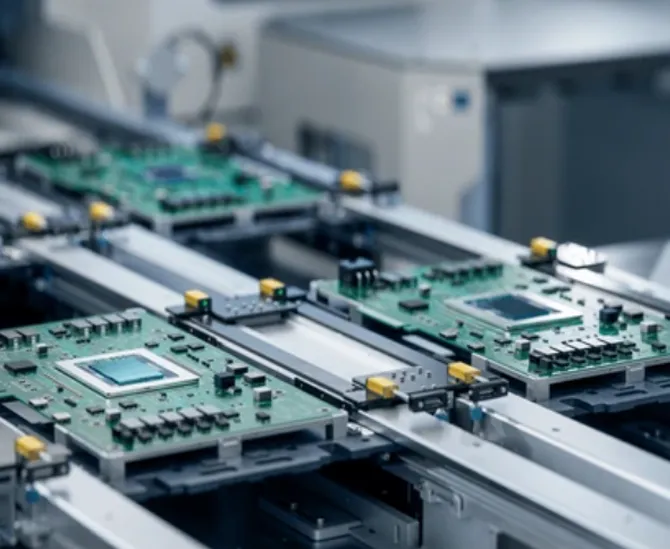
365PCB SMT PCB Assembly Services
Automated SMT PCB assembly for prototype and production projects, with support for common chip components, fine-pitch ICs, and complex packages subject to engineering review.
When evaluating an assembly partner, discuss the BOM, component availability, package mix, stencil requirements, soldering process, AOI and X-ray needs, and functional test expectations before production.
When to Request a Manufacturing Review
Bring your manufacturing partner into the project when the design is stable enough to review but before the final production release. For complex boards, share the layer stack-up, fabrication data, BOM, assembly drawings, component specifications, and performance requirements. This allows engineering teams to identify process constraints while design changes are still manageable.
If you are preparing a new project, you can use the 365PCB instant PCB quote page to begin a quotation request. For an accurate quotation, provide complete and current design files and identify any special materials, impedance, inspection, testing, or delivery requirements.
Our final advice is to qualify the partner before the product becomes urgent. Review the process, ask difficult technical questions, run a pilot build, and agree on measurable quality and delivery expectations. A manufacturing relationship built on evidence is far more valuable than a supplier selected solely because it offered the lowest first quote.
Frequently Asked Questions About Choosing a Microelectronics Manufacturing Partner
1. What does a Microelectronics Manufacturing Partner do?
A Microelectronics Manufacturing Partner may provide PCB fabrication, component sourcing, SMT and through-hole assembly, inspection, electrical testing, functional testing, and production support. The exact scope varies by supplier, so buyers should confirm which processes are performed in-house and which are subcontracted.
2. How do I evaluate a microelectronics manufacturer?
Evaluate relevant technical experience, quality management, PCB fabrication and assembly capability, inspection and test coverage, component traceability, engineering support, production capacity, communication, and quotation transparency. Verify claims through records, audits, technical reviews, and a pilot build.
3. Which certifications should a microelectronics manufacturing partner have?
The required certifications depend on the product and customer. ISO 9001 is a common quality management framework. Automotive, medical, aerospace, and other high-reliability applications may require additional sector-specific standards, customer approvals, or regulatory controls. Always verify the certificate's scope and manufacturing site.
4. Why is DFM important when choosing a PCB manufacturing partner?
DFM identifies design features that may be difficult, costly, or unreliable to fabricate. Early review can address trace and spacing limits, via structures, stack-up, solder mask, panelization, and other process constraints before production files are released.
5. What is the difference between AOI and X-ray inspection?
AOI uses optical imaging to inspect visible PCB and assembly features. X-ray inspection examines internal structures and hidden solder joints, including many BGA connections. The methods serve different purposes and should be selected according to package type, defect risk, and inspection requirements.
6. Should I choose an integrated PCB fabrication and assembly supplier?
An integrated supplier can reduce handoffs and improve coordination between fabrication and assembly. It is a good option when the company has verified capability across the required processes. Confirm which operations are in-house, how subcontractors are controlled, and who is responsible for quality across the complete build.
7. How can I reduce microelectronics manufacturing costs without reducing quality?
Reduce avoidable design complexity, standardize components where appropriate, review DFM early, improve BOM availability, select a suitable production volume, and remove unnecessary process steps only after risk assessment. Do not remove essential inspection, traceability, or testing simply to lower the quotation.
8. Why should a manufacturer conduct a pilot build before mass production?
A pilot build validates the manufacturing documentation, component sourcing, assembly process, inspection plan, test procedure, and production assumptions. It gives the engineering and manufacturing teams an opportunity to resolve issues before committing to larger volumes.
9. What files should I prepare when requesting a PCB manufacturing quotation?
Typical files include Gerber or other fabrication data, NC drill files, board outline, stack-up information, BOM, assembly drawings, pick-and-place data, and relevant specifications. Include special requirements such as impedance control, surface finish, copper weight, inspection, testing, and packaging.
10. How do I know if a manufacturing partner can scale production?
Ask for capacity information, line availability, material planning procedures, bottleneck management, quality trends, and examples of production ramp-ups. Confirm that the supplier can maintain the same approved process, traceability, and acceptance criteria as volume increases.
References
IPC Standards — Industry standards and technical resources for printed circuit boards, electronic assembly, materials, and workmanship.
ISO 9001:2015 — Quality Management Systems — International quality management system requirements and framework.
U.S. Food and Drug Administration — Quality System Regulation — Official information on quality system requirements for medical device manufacturers.