Authored by the Engineering Team at China 365PCB — A fully self-operated, full-industry-chain manufacturing group offering one-stop turnkey services from PCB fabrication to complete OEM/ODM solutions.
Hardware engineering has shifted dramatically toward miniaturization, high-density interconnects, and uncompromising reliability. As product designers attempt to fit increasingly complex logic into shrinking physical envelopes, standard rigid FR4 boards often present insurmountable mechanical limitations. Overcoming these mechanical barriers requires a transition in substrate technology. The core advantage of flexible PCBs lies in their unique material properties, primarily utilizing polyimide (PI) dielectrics and rolled annealed (RA) copper, which fundamentally alters how engineers approach three-dimensional electronic packaging.
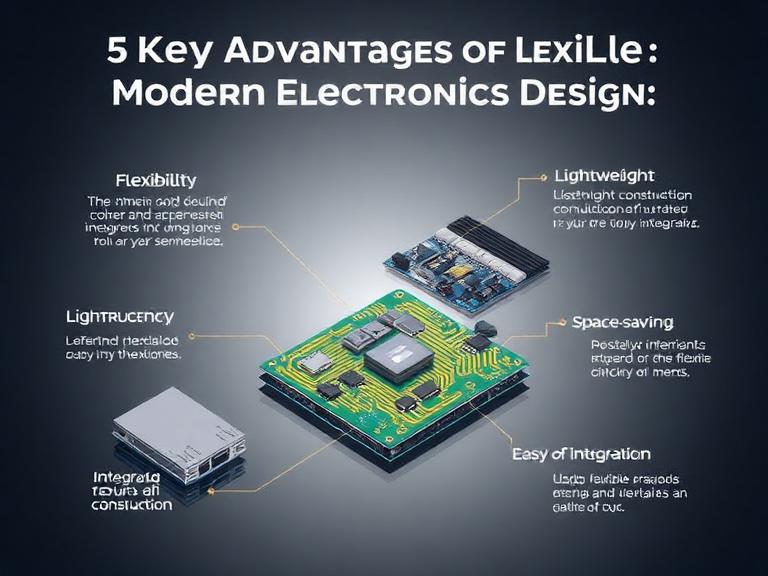
From our experience managing over 100,000 square meters of production area, the transition from rigid boards to flexible circuits solves complex electromechanical problems that traditional wiring harnesses simply cannot. At China 365PCB, our 15+ years of experience dictate that understanding the precise advantage of flexible PCBs is a prerequisite for developing next-generation aerospace, medical, and consumer electronics. We recommend evaluating flexible printed circuits not merely as a replacement for rigid boards, but as an entirely distinct interconnect philosophy.
Table of Contents
Understanding Flexible Circuits and Polyimide Substrates
Flexible printed circuits (FPCs) are manufactured using a flexible polymer film laminated to a thin sheet of highly conductive copper. Unlike rigid printed circuit boards that rely on fiberglass-reinforced epoxy resin, FPCs utilize polyimide. Polyimide exhibits exceptional thermal stability, chemical resistance, and mechanical toughness. When examining the structural advantage of flexible PCBs, the dielectric material thickness is a critical factor. Polyimide films are typically between 12.5 and 50 microns thick, allowing the entire circuit profile to remain exceptionally thin.
This thin profile requires specialized manufacturing processes. The copper foil utilized in high-flex applications is typically rolled annealed rather than electrodeposited. Rolled annealed copper possesses a horizontal grain structure that aligns with the bending axis, preventing micro-fractures during dynamic flexing. We recommend specifying rolled annealed copper whenever the application requires continuous bending cycles, such as in hard drive actuator arms or folding smartphone displays.
The Primary Advantage of Flexible PCBs
While there are numerous benefits to this technology, the paramount advantage of flexible PCBs is three-dimensional spatial efficiency. Standard rigid boards operate on a two-dimensional plane. Connecting multiple rigid boards at different angles requires bulky wire harnesses, ribbon cables, and physical connectors. These traditional interconnects consume a vast amount of internal volume, increase the overall weight of the device, and restrict airflow.
The spatial advantage of flexible PCBs eliminates these constraints entirely. A single flexible circuit can be designed to conform to the contours of the device housing, bending precisely where necessary to interconnect multiple components without a single discrete wire or connector. From our experience in high-density assembly, replacing a rigid-board-and-cable assembly with a single flexible or rigid-flex circuit can reduce the internal volume requirement by up to 70 percent. This reduction directly translates into slimmer product profiles and larger available volumes for battery capacity.
Another crucial advantage of flexible PCBs is weight reduction. The mass of a polyimide substrate combined with thin copper traces is a fraction of the mass of a multi-layer FR4 board and its associated copper cabling. In industries such as aerospace, satellite manufacturing, and uncrewed aerial vehicles (UAVs), where launch costs are calculated by the gram, this weight reduction represents a massive financial and operational benefit.
Mechanical Reliability and Vibration Resistance
A frequently overlooked advantage of flexible PCBs is their profound impact on system reliability. Wire harnesses and mechanical connectors are notorious points of failure in electronic assemblies. Connectors can become unseated due to thermal expansion and contraction, while wire crimps can degrade due to oxidation or mechanical stress. By consolidating multiple interconnected rigid boards into a single flexible circuit, engineers eliminate the physical interfaces where failures most commonly occur.
Furthermore, the mass and stiffness of a circuit board dictate its response to mechanical shock and vibration. Rigid boards have a higher mass and can resonate destructively under specific vibration frequencies, potentially causing solder joint fractures on heavy components. The advantage of flexible PCBs in harsh environments is their low mass and high ductility. A flexible circuit absorbs and dissipates vibrational energy rather than transferring it to the solder joints. We recommend flexible circuits for automotive engine control units, industrial robotics, and military ballistics, where extreme shock and vibration profiles are operational norms.
Thermal Management and High-Speed Signal Integrity
Heat dissipation is a persistent challenge in modern electronics. The thermal advantage of flexible PCBs is closely related to their physical geometry. Because the polyimide dielectric is exceptionally thin, the thermal path from the heat-generating component to the cooling structure is significantly shorter than in a standard FR4 board. Furthermore, flexible circuits can be physically wrapped around metallic heat sinks or chassis components, utilizing the entire product housing as a thermal dissipator. We recommend exploiting this advantage of flexible PCBs when designing high-power LED arrays or compact power conversion modules.
Regarding signal integrity, flexible substrates offer highly consistent dielectric constants. Polyimide provides excellent electrical isolation and uniform electrical properties across varying temperatures. When designing a High-speed PCB, controlling impedance is mandatory. The tight manufacturing tolerances associated with flex circuits allow for highly precise trace widths and dielectric spacing, ensuring stable characteristic impedance for high-frequency differential pairs. This is why the advantage of flexible PCBs is frequently leveraged in high-speed data transmission cables and telecommunications equipment.
Summary Table: Flexible vs. Rigid PCB Characteristics
| Characteristic | Rigid PCB (FR4) | Flexible PCB (Polyimide) | Key Engineering Impact |
|---|
| Mechanical Ductility | Rigid, inflexible | High dynamic and static flex capability | Allows 3D packaging and eliminates connectors |
| Substrate Thickness | Typically 0.8mm to 3.2mm | Typically 0.05mm to 0.25mm | Massive reduction in spatial volume requirements |
| Weight / Mass | Heavy, varying by layer count | Extremely lightweight | Critical for aerospace and wearable technology |
| Vibration Tolerance | Moderate, prone to solder fatigue | Excellent, absorbs physical shock | Increases MTBF (Mean Time Between Failures) |
| Heat Dissipation | Moderate, thick dielectric impedes transfer | Excellent due to thin dielectric layer | Improves thermal management in tight enclosures |
China 365PCB Advanced Manufacturing Capabilities
Realizing the full advantage of flexible PCBs requires a manufacturing partner capable of executing complex designs with absolute precision. China 365PCB is a fully self-operated, full-industry-chain manufacturing group. We manage everything from PCB fabrication and SMT assembly to online electronic component sourcing and integration, CNC machining, cable harness assembly, and complete OEM/ODM solutions.
At China 365PCB, we believe true manufacturing excellence lies in Speed, Precision, and Responsibility. We never outsource, never compromise. Because all facilities are self-owned and self-managed across our 100,000 square meters of production area, we ensure total quality control, full process traceability, and unmatched production flexibility. When a client requires a complex rigid-flex assembly, every board, every circuit, and every connection is made within our own facilities.
Our engineering expertise extends well beyond standard flexible circuits. For the semiconductor testing industry, reliability and extreme precision are non-negotiable. We manufacture advanced IC substrate and testing solutions including the FC-CSP PCB, Interposer PCB, Burn in Board PCB, Probe Card PCB, Semiconductor Test PCB, and Load Board PCB. By applying the same rigorous quality control required for a High-speed PCB or a dense Load Board PCB to our flexible circuit manufacturing lines, we guarantee that you always get faster delivery, higher quality, and absolute reliability. We encourage engineers to utilize our PCB Instant Quote system to accelerate their development cycles and truly realize 365 days of fast manufacturing.
Frequently Asked Questions (FAQs)
What is the primary advantage of flexible PCBs over standard cable harnesses?
The primary advantage of flexible PCBs over cable harnesses is the elimination of manual wiring errors, significant weight reduction, and the removal of bulky mechanical connectors. Flexible circuits provide a single, repeatable, and highly reliable interconnect solution that improves signal integrity and reduces assembly time.
Can flexible PCBs support high-speed digital signals?
Yes. A major advantage of flexible PCBs is the uniformity of the polyimide dielectric. This consistency allows manufacturers like China 365PCB to maintain strict impedance control, making flexible circuits ideal for high-speed data transfer applications, such as USB 3.0, HDMI, and advanced telecommunications routing.
What is the difference between static and dynamic flexing?
Static flexing (bend-to-install) means the flexible PCB is bent once during assembly to fit into the device enclosure and remains in that position permanently. Dynamic flexing requires the circuit to bend continuously during the device's operation, such as in a robotic arm. Understanding this difference is critical, as dynamic flexing requires specific copper grain structures (rolled annealed) and precise bend radius calculations.
Industry References
 English

_20260729092846.webp "8 Best Options for Hobbyist PCB Manufacturing in the UK (2026 Guide)")