Authored by China 365PCB, a fully self-operated, full-industry-chain manufacturing group offering one-stop turnkey solutions from PCB fabrication to complete OEM integration. With 15+ years of experience and over 100,000㎡ of self-owned production area, we deliver speed, precision, and responsibility. We never outsource, never compromise.
The electronic design automation EDA landscape is undergoing a massive transformation. For decades, hardware engineers relied entirely on manual routing, painstaking schematic creation, and iterative prototype testing to bring a printed circuit board to life. Today, engineering teams seek to accelerate their time-to-market without compromising signal integrity or mechanical reliability. The modern answer to this challenge is learning how to make circuit board with ai. Artificial intelligence is no longer a theoretical concept; it is actively shaping how schematics are drawn, how components are placed, and how complex multi-layer routing is executed.
From our experience operating a 100,000㎡ self-managed manufacturing facility, we observe a distinct difference in the digital files we receive. Files generated when hardware teams make circuit board with ai exhibit superior impedance control, highly optimized component density, and virtually zero design rule check DRC errors. Artificial intelligence acts as a co-pilot, predicting thermal hotspots and supply chain bottlenecks long before a single copper layer is etched. In this authoritative guide, we will outline the architectural shift in EDA software and demonstrate step-by-step how to make circuit board with ai, seamlessly bridging the gap between digital generative design and physical manufacturing.
1. The Evolution of Electronic Design Automation
Historically, automated tools in PCB design were heavily restricted by algorithmic limitations. The legacy autorouters of the 1990s and 2000s utilized topological algorithms that often created messy, illogical copper traces, requiring engineers to spend hours ripping up and rerouting traces manually. When you set out to make circuit board with ai today, you are utilizing a fundamentally different technology. Modern AI utilizes deep reinforcement learning, a branch of machine learning where the software trains itself by evaluating millions of previous PCB designs to understand spatial awareness, return paths, and electromagnetic interference EMI principles.
We recommend integrating AI copilots directly into your existing EDA software. Tools like Flux, Copilot for Altium, and Zuken's AI routing modules allow engineers to input high-level constraints, and the AI handles the repetitive geometry. By choosing to make circuit board with ai, your engineering team can transition their focus from drawing lines on a screen to optimizing the overall system architecture and user experience.
2. Generative Schematics and Component Selection
The first step to make circuit board with ai involves schematic generation. Natural Language Processing NLP models have advanced to the point where an engineer can type a prompt such as, "Generate a schematic for a 5V to 3.3V buck converter capable of 2A output, utilizing automotive-grade components." The AI parses the request, accesses vast libraries of reference designs, and instantly drafts a highly optimized schematic diagram.
Simultaneously, the AI evaluates the global supply chain. A major bottleneck in traditional design is specifying a component only to discover it has a 50-week lead time during the manufacturing phase. When you make circuit board with ai, the system actively filters out obsolete or out-of-stock parts. However, a digital design is only as reliable as the physical components used to assemble it. To guarantee your AI-selected Bill of Materials BOM is authentic and readily available, we integrate directly with our Electronic Components sourcing service. Because China 365PCB operates a fully self-operated supply chain, we validate your AI-generated BOM against real-time global inventory, ensuring zero delays in your prototyping phase.
3. Deep Reinforcement Learning for PCB Autorouting
Routing a high-density interconnect HDI board with BGA packages is notoriously time-consuming. When you make circuit board with ai, this process is condensed from weeks into minutes. Instead of simple point-to-point connections, AI models evaluate the board as a multidimensional grid. The AI assesses signal speed, cross-talk potential, and current capacity before placing a trace.
From our experience manufacturing millions of boards, human routing often struggles with differential pair matching and precise length tuning across complex multi-layer stacks. AI handles these strict tolerances flawlessly. Furthermore, when you make circuit board with ai, the system automatically optimizes via placement. It will strategically deploy microvias, blind vias, and buried vias to conserve board real estate while maintaining structural integrity. The result is a fabrication file that is infinitely easier for our PCB Manufacturing facility to process, leading to higher manufacturing yields and lower costs for our clients.
4. Predictive Simulation for Thermal and Signal Integrity
One of the most powerful reasons to make circuit board with ai is the integration of predictive simulation. Traditional workflows require a board to be designed, exported, and imported into a separate simulation suite like Ansys or HyperLynx to test for thermal buildup or signal degradation. This creates a slow, iterative loop.
Modern AI continuously simulates the board in real-time as it is being designed. If an engineer places a high-power MOSFET too close to a sensitive microcontroller, the AI immediately flags the thermal gradient violation and suggests an alternate placement or the addition of thermal relief vias. This proactive approach ensures that the design you send to production works perfectly on the first run. At China 365PCB, our commitment to speed, precision, and responsibility aligns perfectly with this methodology. By utilizing AI to eliminate design flaws digitally, we guarantee that the physical product we deliver meets your exact functional expectations.
5. Transitioning AI Designs to Physical Manufacturing
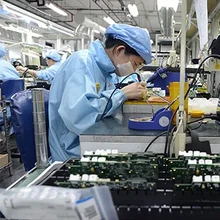
The ultimate goal of learning how to make circuit board with ai is to produce a tangible, physical product. It is critical to understand that an AI-generated design is only a blueprint. True manufacturing excellence lies in the physical realization of that digital file. We never outsource, never compromise. If you generate a flawless design with AI but send it to a fragmented supply chain, you risk component counterfeiting, poor solder joints, and severe delays.
Once you make circuit board with ai, the digital handoff to a full-industry-chain manufacturer is essential. Our PCB assembly lines utilize automated optical inspection AOI and 3D X-ray systems that sync with your AI-generated pick-and-place files. Because all facilities are self-owned and self-managed within our 100,000㎡ production area, we maintain absolute quality control over the AI's exact specifications.
Furthermore, a printed circuit board rarely exists in isolation. It requires an enclosure and external wiring. While you make circuit board with ai, you can also utilize AI to generate the mechanical housing and cable requirements. We support these complete OEM/ODM solutions through our advanced CNC/3D Printing services and our dedicated Connectors & Harness Assembly division. From PCB to OEM integration, every board, every circuit, and every connection is made within our own facilities, truly realizing 365 days of fast manufacturing for global customers.
6. Summary Table: Traditional vs. AI-Assisted PCB Design
To clearly illustrate the paradigm shift, we have constructed a matrix detailing the differences between legacy design methodologies and the modern workflow when you make circuit board with ai.
| Process Stage | Traditional PCB Design Workflow | Workflow When You Make Circuit Board With AI | Impact on Manufacturing China 365PCB |
|---|
| Schematic Generation | Manual symbol drawing and connection mapping. | Prompt-based generation utilizing NLP and reference libraries. | Standardized schematics reduce tooling and setup errors. |
| Component Sourcing | Manual checking of distributor websites for stock. | Predictive API integration identifying end-of-life and lead times. | Zero delays during our in-house electronic component procurement. |
| Component Placement | Intuition-based placement; highly prone to thermal errors. | Algorithmic placement optimizing for shortest signal path and thermal dissipation. | Higher SMT yields during automated assembly. |
| Trace Routing | Manual clicking or reliance on flawed topological autorouters. | Deep reinforcement learning evaluating impedance, cross-talk, and EMI. | Fewer fabrication failures; highly consistent impedance control. |
| Design Verification | Post-design DRC checks and separated simulation software. | Real-time predictive simulation preventing errors before they are drawn. | "First-Time-Right" manufacturing, dramatically reducing prototype cycles. |
7. Frequently Asked Questions FAQs
Will AI completely replace hardware engineers in PCB design?
No. While you can make circuit board with ai to handle the repetitive, geometrically complex tasks of routing and placement, the system architecture, mechanical constraints, and ultimate operational logic still require human engineering expertise. AI acts as a powerful co-pilot, not an autonomous replacement.
Can I use AI to design high-frequency RF circuit boards?
Yes, advanced AI models are increasingly capable of handling Radio Frequency RF design. Because AI relies on strict mathematical models, it excels at maintaining specific trace widths and spacing required for high-frequency impedance control. However, we recommend thorough human review of any AI-generated RF design prior to submitting it to our PCB manufacturing facility.
Does China 365PCB accept AI-generated manufacturing files?
Absolutely. We accept standard Gerber RS-274X, ODB++, and IPC-2581 files regardless of whether they were routed manually or generated via AI. Because we operate a fully self-operated manufacturing group, our CAM engineers will review your AI-generated files to ensure they align perfectly with our physical manufacturing tolerances.
How does AI reduce the cost of PCB manufacturing?
When you make circuit board with ai, the software inherently minimizes layer counts and optimizes board space, resulting in smaller, cheaper boards. Additionally, by preventing DRC errors and supply chain bottlenecks, AI eliminates the need for costly prototype revisions and emergency component sourcing.
8. Industry References
To further understand the integration of artificial intelligence within electronic design automation, and the standards required for physical hardware manufacturing, we encourage reviewing the following authoritative sources:
 English